
Aging and invoices
AR aging report and sample invoices
Business Capital Advisors
Turn unpaid invoices into working capital today.
Invoice factoring (recourse and non-recourse), spot factoring, accounts-receivable lines, and purchase-order (PO) financing, bridge the gap between billing and getting paid.
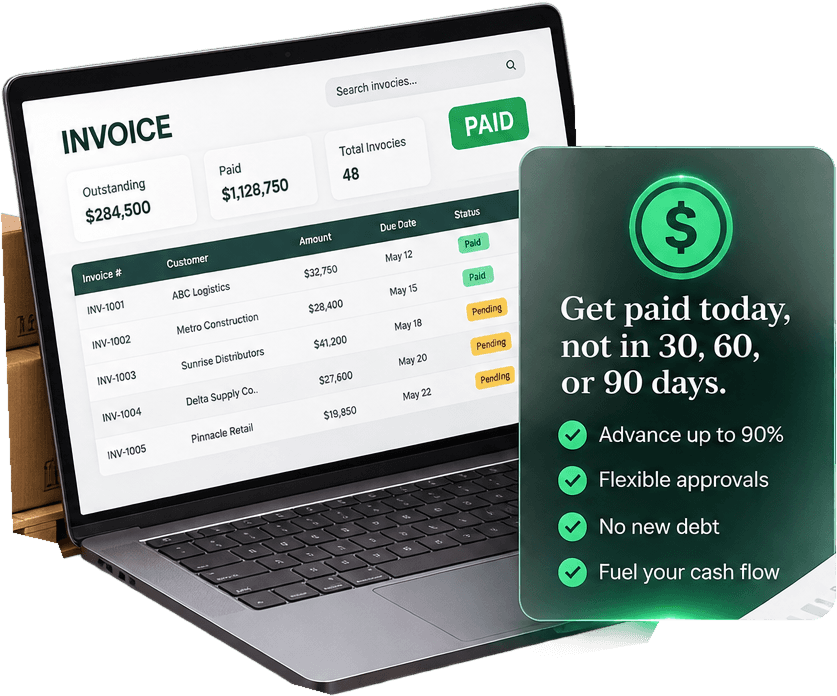


Is this the right solution?

Cover weekly payroll while approved B2B invoices remain on 30-, 60-, or 90-day customer terms.
Popular for: Staffing firms · Agencies · Professional services
Checking options won't affect your credit score.
*Illustrative factoring estimate. Fees typically accrue until the customer pays. Actual advance, fee, reserve, recourse terms, and timing depend on the invoice, payor, agreement, and funding partner.
Where businesses use receivables financing
Product definition
Receivables financing turns eligible business invoices into working capital before customers pay. Approval centers on the invoice, the customer’s ability to pay, and the underlying transaction, making cash timing the core business question.
How receivables financing works
Share the business, customer, and invoice details.
The factor reviews the invoices and customer credit.
Receive the agreed advance against eligible invoices.
The reserve, less the agreed fee, is released after collection.
What you'll need
AR aging report and sample invoices
Customer list with contact and payment terms
3 months of business bank statements
We keep your information secure and private.
Common questions
Factoring terms depend on invoice quality, customer credit, payment timing, and the agreement. Start with the questions operators ask first.
No. Factoring is the sale of an invoice at a discount: you receive most of its value now (commonly an 80-90% advance) and the balance minus the factor's fee when your customer pays. There is no monthly loan payment.
Under notification factoring, yes, they pay the factor directly and the factor verifies invoices with them. Non-notification arrangements exist for stronger books. Either way, factoring is routine in B2B industries like freight and staffing.
Fees commonly run 1-3% per 30 days on the invoice face value, driven by your customers' credit and payment speed, not yours. A $10,000 invoice at a 2% monthly fee costs $200 if paid in 30 days.
Depends on the agreement. With recourse factoring, you buy the invoice back. Non-recourse shifts defined credit risk to the factor for a higher fee. Read which events are actually covered, non-recourse rarely covers disputes.
Clear advance mechanics. Flexible programs. Built around your receivables.