
Aging reports
AR and AP aging reports
Business Capital Advisors
Borrow against the assets already on your balance sheet.
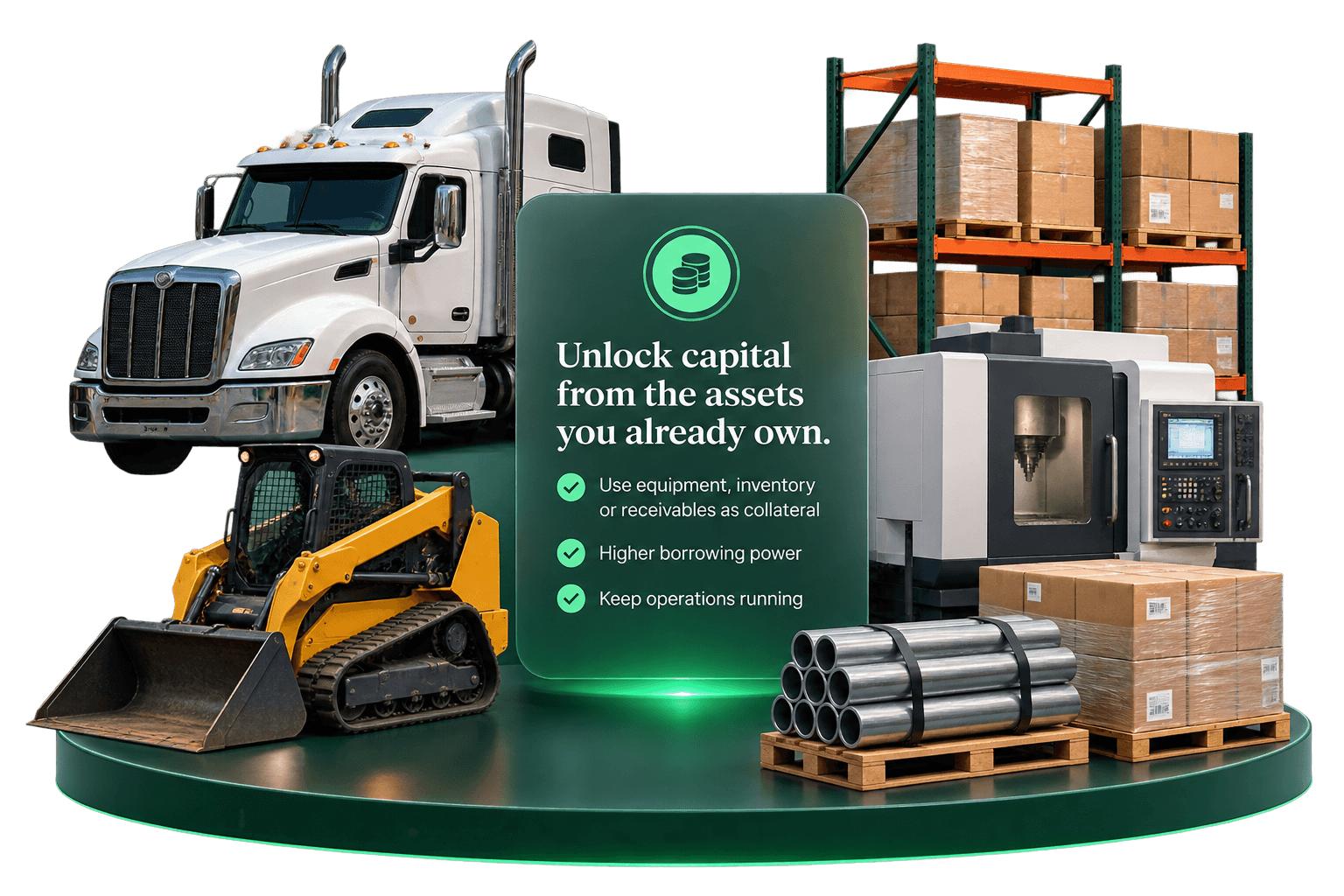
Use eligible receivables, inventory, equipment, or other business assets to support a revolving facility that can grow with your operating base.
Is this the right solution?

Borrow against completed, collectible invoices while your team keeps billing customers and managing collections.
Common for: Distributors · Staffing firms · Manufacturers · Business services
Checking options won't affect your credit score.
*Illustrative estimate only. Gross borrowing base equals selected eligible receivables multiplied by the receivables advance rate, plus selected eligible inventory multiplied by the inventory advance rate. Actual eligibility, advance rates, reserves, concentrations, appraisals, lien position, fees, and availability are set by the funding partner after underwriting and a collateral review.
Explore common collateral
Product definition
Asset-based financing is a revolving business facility supported by eligible receivables, inventory, equipment, or commercial property. Available credit changes with the borrowing base, so the structure can expand as qualified business assets grow.
How Asset-Based Financing works
Share the capital need and the assets supporting it.
Funding partners review financials, agings, and collateral records.
Records, controls, value, and lien position are validated.
Advance rates, reserves, reporting, and covenants are documented.
Access capital as eligible assets build the borrowing base.
What you'll need
AR and AP aging reports
Inventory or equipment lists with values
Financial statements and recent tax returns
We keep your information secure and private.
Common questions
Eligibility, advance rates, reserves, and reporting determine real availability. Start with the questions operators should settle before opening a facility.
Accounts receivable and inventory are the core, with equipment and sometimes real estate layered in. Availability is strongest on receivables from creditworthy B2B customers.
Through a borrowing base: commonly up to 80-85% of eligible receivables and 50% or less of eligible inventory, recalculated as those balances move. Growth in sales grows availability automatically.
With ABL you keep billing and collecting from your customers and borrow against the receivables. With factoring, the factor purchases invoices and usually takes over collection contact. ABL suits larger, more established books.
Facilities generally start making sense around $250K and scale into the tens of millions. Below that, factoring or a revenue-based product usually fits better, we will tell you which side of the line your file sits on.
A transparent borrowing base. Revolving availability. Built around assets you already own.